If you feel stressed all the time — tight chest, racing thoughts, irritability, exhaustion that never quite goes away — you’ve probably asked yourself some version of this:
“Why can’t I just calm down?”
You’ve tried the tips.
You’ve downloaded the meditation apps.
You’ve told yourself to relax, breathe, let it go.
And yet… your body still feels on edge.
Here’s the truth most people are never told:
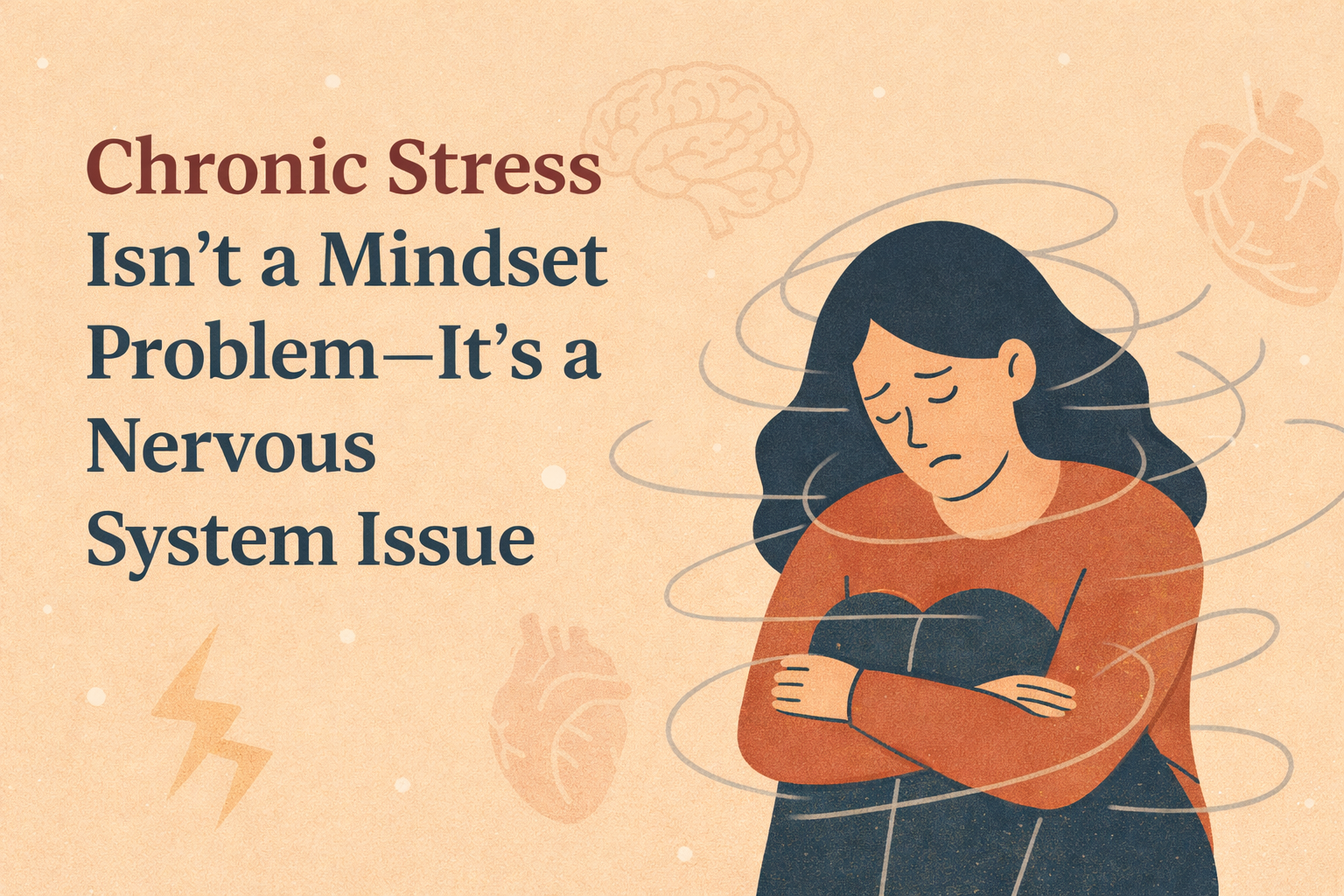
Chronic stress isn’t a failure of willpower or mindset. It’s a nervous system that’s stuck in survival mode.
And until you work with your nervous system — not against it — stress management will keep feeling like an uphill battle.
Let’s break this down in a way that actually makes sense.
What Stress Really Is (And What It Isn’t)
Stress is often framed as something mental: worrying too much, overthinking, being “high-strung.”
But biologically, stress is a body response, not a thought problem.
When your nervous system detects threat — real or perceived — it activates survival pathways designed to keep you safe:
- Increased heart rate
- Shallow breathing
- Muscle tension
- Heightened alertness
- Reduced digestion and rest functions
This is helpful in short bursts.
It’s not helpful when it becomes your default state.
Acute Stress vs. Chronic Stress
- Acute stress: A short-term response to a specific situation (a deadline, an argument, a close call).
- Chronic stress: When your body stays activated long after the threat has passed — sometimes for months or years.
Chronic stress often looks like:
- Constant fatigue, even after rest
- Feeling “wired but tired.”
- Emotional reactivity or numbness
- Difficulty concentrating
- Trouble sleeping or staying asleep
At this point, stress isn’t something you think your way out of.
It’s something you regulate your way through.
Why Your Nervous System Gets Stuck in Stress Mode
Your nervous system learns through repetition.
If you’ve experienced:
- Ongoing pressure without recovery
- Emotional invalidation
- Trauma or chronic unpredictability
- Burnout
- Long-term caretaking or emotional labor
Your body may have learned:
“I need to stay alert to survive.”
This isn’t a weakness.
It’s an adaptation.
The problem is that once this pattern sets in, your body can start reacting to non-dangerous situations as if they’re threats:
- Emails feel urgent and overwhelming
- Social interactions feel draining
- Rest feels uncomfortable
- Silence feels unsafe
Stress becomes your baseline — not because something is wrong with you, but because your nervous system hasn’t learned how to power down.
Why Traditional Stress Advice Often Fails
You’ve probably heard things like:
- “Just take deep breaths.”
- “Practice gratitude”
- “Think positive”
- “Try to relax.”
These aren’t bad suggestions — but they’re incomplete.
When your nervous system is highly activated:
- Your brain is not prioritizing logic
- Your body is not receptive to calm language
- Your system is scanning for danger, not affirmations
That’s why stress management needs to start bottom-up (body first), not top-down (thoughts first).
The Missing Piece: Nervous System Regulation
Nervous system regulation means helping your body move out of survival mode and back into a state of relative safety.
This doesn’t require hours of meditation or a complete lifestyle overhaul.
It requires small, repeated signals of safety.
Below are practical, therapist-informed strategies that actually help reduce chronic stress — because they speak the language your nervous system understands.
1. Use the Body to Interrupt Stress (Before the Mind Can)
When stress spikes, your body needs physical input to shift gears.
Try one of these:
- Cold water on the face or wrists
- Pressing your feet firmly into the floor
- Gentle stretching or shaking out tension
- Holding something cold, warm, or textured
These sensory inputs send a message to your nervous system:
“Something has changed. You can recalibrate.”
This is why distress tolerance tools from DBT are so effective for stress — they bypass overthinking and work directly with physiology.
2. Breathe in a Way That Signals Safety (Not Performance)
Not all breathing calms the nervous system.
When stressed, aim for:
- Longer exhales than inhales
- Slow, unforced breathing
- No pressure to “do it right.”
A simple option:
- Inhale for 4
- Exhale for 6
Longer exhales activate the parasympathetic nervous system — the part responsible for rest and recovery.
3. Stop Asking “Why Am I Like This?”
This question sounds logical — but it often fuels stress and shame.
Instead, try:
- “What does my nervous system need right now?”
- “What would help my body feel 5% safer?”
Stress decreases faster when curiosity replaces self-criticism.
4. Reduce Stress by Creating Predictable Micro-Routines
Your nervous system thrives on predictability.
You don’t need a rigid schedule — just small anchors:
- The same morning drink
- A consistent wind-down habit
- A short daily walk
- One repeated grounding practice
These routines create felt safety, which lowers baseline stress over time.
5. Separate Stress From Identity
Many people start to believe:
- “I’m just an anxious person.”
- “I’m bad at handling stres.s”
- “This is just who I a.m”
But stress is a state, not a trait.
When you externalize stress (“my nervous system is activated”) instead of internalizing it (“I’m failing”), your body often softens — because the threat of self-judgment is removed.
6. Build Recovery Into Your Life (Not Just Productivity)
Chronic stress often comes from an imbalance:
- Too much output
- Too little recovery
Recovery isn’t a reward.
It’s a biological requirement.
Recovery can look like:
- Stillness
- Low-stimulation activities
- Gentle movement
- Quiet connection
If rest feels uncomfortable, that’s often a sign your nervous system hasn’t practiced it yet — not that you’re doing it wrong.
7. Focus on Regulation, Not Elimination
The goal isn’t to eliminate stress forever.
The goal is:
- Faster recovery after stress
- Less intensity
- More flexibility
Stress becomes manageable when your nervous system learns:
“I can come back from this.”
That’s resilience — not toughness.
Final Thoughts: You’re Not Broken — You’re Adapted
If stress has been running your life, it doesn’t mean you’re weak, dramatic, or incapable.
It means your nervous system learned how to survive — and now it needs help learning how to rest.
Stress management isn’t about fixing yourself.
It’s about teaching your body that safety is possible again.
And that’s a skill you can learn.
One breath.
One pause.
One small signal of safety at a time.