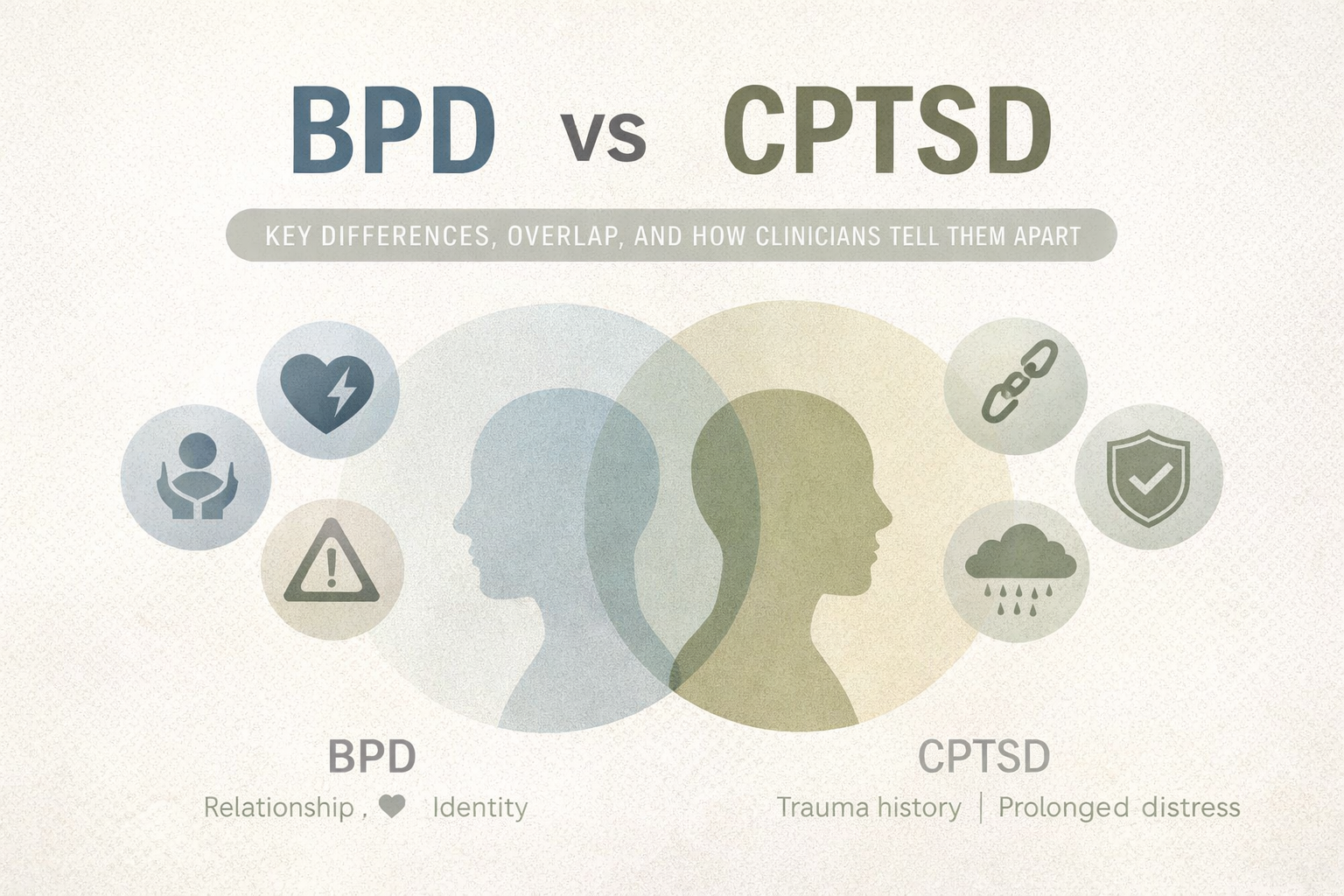
BPD vs CPTSD is one of the most confusing comparisons in mental health because the overlap is real. Both can involve emotional flooding, shame, relationship distress, reactivity, and the sense that your nervous system takes over before your thinking catches up. But clinicians do not sort this out by symptom checklists alone. They also look at trauma, timing, identity, relationships, and what the distress seems to organize around.
60-Second Answer
BPD and CPTSD can look similar from the outside, but they are not the same.
- BPD is usually understood through patterns in emotion regulation, identity, and relationships.
- CPTSD is usually understood through prolonged trauma, PTSD symptoms, and chronic disruptions in safety, self-concept, and connection.
- Both can involve shame, reactivity, and relationship pain.
- Some people have both.
- You cannot reliably sort this out from one article, one symptom, or one online checklist.
The goal is not to guess your label from the internet. The goal is to ask better questions.
And if the hardest part is what happens when everything floods at once, start with the When Everything Is Too Much guide.
In high-intensity moments, a simple stabilizing plan is often more helpful than a perfect explanation.
TOC / Jump Links
- Why this gets confused
- Universal first move
- What is the difference between BPD and CPTSD?
- BPD vs CPTSD: A Quick Side-by-Side Comparison
- Can you have both BPD and CPTSD?
- Try this now
- If You Already Reacted (Repair in 10 Seconds)
- Common mistakes
- FAQs
- What to do next
Why this gets confused
These two get confused because they share visible features.
A person with BPD may look overwhelmed, reactive, ashamed, and intensely sensitive in relationships.
A person with CPTSD may look overwhelmed, reactive, ashamed, and intensely sensitive in relationships too.
That is why surface-level symptom matching can miss the bigger pattern.
A person with trauma may get labeled too quickly. A person with BPD may get reduced to “just trauma” in a way that misses clinically important patterns. And sometimes the most accurate answer is not one or the other. It is both.
Universal first move
Before trying to decide what fits, slow the process down.
- Notice what feels familiar.
- Do not treat familiarity as proof.
- Write down the patterns you want to ask about in therapy.
- If you are already flooded, regulate first and analyze later.
A diagnosis is not a personality verdict. At its best, it is a treatment map.
What is the difference between BPD and CPTSD?
The shortest useful answer is this:
The difference is not just which symptoms show up. It is also what those symptoms seem to be organized around.
BPD is usually framed around enduring difficulties with emotion regulation, identity, and relationships. CPTSD is usually framed around prolonged trauma and often includes PTSD symptoms alongside chronic shame, relationship disruption, and a damaged or cut-off sense of self.
That is the broad distinction. Real assessment is more nuanced than that. But it is a useful starting point.
BPD vs CPTSD: A Quick Side-by-Side Comparison
Path 1: What it feels organized around
What it feels like
BPD may feel more organized around abandonment, rupture, or disconnection.
CPTSD may feel more organized around danger, control, helplessness, or chronic unsafety.
Signs
- intense reactions to rejection or mixed signals
- intense reactions to threat, power, or feeling trapped
- shame in both
- relationship pain in both
Do this first
- Think about your last three big reactions.
- Ask what the fear underneath was.
- Write down the repeating theme.
One tool
Finish this sentence three times:
“When I get activated, it usually feels like ________.”
Path 2: Sense of self
What it feels like
In BPD, the self may feel unstable, shifting, or hard to hold onto under stress.
In CPTSD, the self may feel buried, damaged, small, or cut off.
Signs
- unstable self-image
- chronic shame
- feeling fragmented
- feeling erased or disconnected from yourself
Do this first
- Notice whether your self-experience feels more unstable or more shut down.
- Bring that pattern into therapy.
One tool
Write two prompts:
- “I lose myself by becoming…”
- “I lose myself by disappearing…”
See which feels more central.
Path 3: Relationships
What it feels like
In BPD, relationships may feel intense, urgent, and easily destabilized by perceived disconnection.
In CPTSD, relationships may feel unsafe, hard to trust, or hard to relax into even when the other person seems steady.
Signs
- fear of abandonment
- push-pull dynamics
- guardedness
- hypervigilance
- bracing for harm
Do this first
- Notice what happens when closeness increases.
- Ask whether the fear feels more like “leave” or “harm.”
One tool
After a hard interaction, write:
- What happened
- What I thought it meant
- What I feared next
Path 4: Trauma symptoms
What it feels like
This is where online comparisons often get too thin.
CPTSD is not just trauma plus big feelings. Trauma symptoms are central.
Signs
- re-experiencing
- avoidance
- hypervigilance
- chronic threat scanning
- negative self-concept
Do this first
- Ask whether trauma symptoms are central to the picture.
- Bring flashbacks, avoidance, and dissociation into the conversation directly.
One tool
List:
- What I relive
- What I avoid
- What makes my body act like danger is here
Can you have both BPD and CPTSD?
Yes.
For some people, both is the more accurate picture.
That is why this should not be treated like a quiz result. The question is not which label wins. The question is what formulation best explains the full pattern.
A thoughtful assessment may find trauma-based symptoms, enduring relational patterns, identity disturbance, or some combination of all three.
Try this now
If reading this made you more activated, stop researching for a minute.
- Put both feet on the floor.
- Name five things you can see.
- Exhale longer than you inhale.
- Ask: “Do I need more explanation right now, or do I need regulation first?”
Sometimes that question is more useful than another hour of symptom comparison.
If You Already Reacted (Repair in 10 Seconds)
If you already spiraled, snapped, shut down, or panic-searched:
- Pause.
- Stop adding fuel.
- Name what happened without shaming yourself.
- Try: “I’m overloaded. I want to come back to this more clearly.”
- Give yourself ten minutes before the next message, decision, or conclusion.
Repair usually starts with reducing intensity, not with finding the perfect explanation.
Common mistakes
Mistake 1: Treating this like a quiz
This is not a sorting hat. It is a differential diagnosis question.
Mistake 2: Assuming trauma history automatically means CPTSD
Trauma matters. It does not answer the whole picture by itself.
Mistake 3: Assuming fear of abandonment automatically means BPD
That can show up in trauma too.
Mistake 4: Using one symptom as proof
Dissociation, shame, anger, emotional flooding, and relationship distress can all cross categories.
Mistake 5: Treating BPD like a character judgment
It is not. Stigma is not clinical accuracy.
Mistake 6: Researching while dysregulated
Once you are activated, you are more likely to read from fear instead of pattern.
If this kind of comparison tips you into overload, start with the When Everything Is Too Much guide.
When your system is overwhelmed, something simple and stabilizing is usually more useful than more late-night symptom searching.
FAQs
Can CPTSD be mistaken for BPD?
Yes. That can happen when visible reactivity or relationship pain gets more attention than trauma history, PTSD symptoms, and chronic threat patterns.
Can BPD and CPTSD look similar?
Yes. That is why this comparison is confusing and why symptom lists alone are not enough.
What is the main difference in BPD vs CPTSD?
A useful shorthand is that BPD is usually framed more around emotion, identity, and relationship instability, while CPTSD is framed around prolonged trauma and its effects.
Is fear of abandonment part of CPTSD too?
It can be. Trauma can affect attachment and relationship safety deeply. The question is whether that fear is one feature or a more central organizing pattern.
Does CPTSD include identity problems?
Yes. But it may show up more as shame, self-erasure, or a damaged sense of self than the instability more often discussed in BPD.
Is BPD always caused by trauma?
No. Trauma is common, but BPD is not defined solely by trauma history.
Can you have both BPD and CPTSD?
Yes. Some people meet criteria for both.
How do clinicians tell them apart?
They look at history, trauma, symptom clusters, relationships, identity, dissociation, impulsivity, and what the distress seems to organize around over time.
Should I diagnose myself from articles like this?
No. Articles like this can help you ask better questions, but they cannot replace a qualified assessment.
Why does the distinction matter?
Because treatment fit matters. A more accurate formulation usually leads to better support and a more useful therapy focus.
What to do next
If this felt clarifying, let it be a starting point, not a verdict.
A useful sentence to bring into therapy is:
“I want to explore whether what I’m dealing with fits BPD, CPTSD, or both.”
That is a grounded clinical question.
And if the hardest part is not the label but what happens when everything floods at once, start with the When Everything Is Too Much guide.
In high-intensity moments, a simple stabilizing plan is often more helpful than a perfect explanation.
Then watch next: BPD vs Autism vs C-PTSD: Why They Look So Similar
For immediate crisis support in the US, contact the 988 Suicide & Crisis Lifeline: https://988lifeline.org/
This article is for educational purposes only. It is not a substitute for diagnosis, therapy, or mental health treatment.