When the explanation is off, people can spend years trying to fix the wrong problem.
That is part of what makes conversations about Autism and BPD in women so loaded. A trait gets labeled. A behavior gets treated like the explanation. And a lot of people are left trying to make sense of a diagnosis, a misdiagnosis, or a pattern that never fully fits.
This is not because the overlap is fake. It is because the overlap is real enough to confuse people when the visible trait gets more attention than the pattern underneath it.
Emotional intensity can look similar across different experiences. Relationship distress can look similar. Identity confusion can look similar. Even self-harm, shutdown, numbness, or chronic emptiness can get flattened into one story too fast.
But the same trait can look similar on the outside and mean something different underneath.
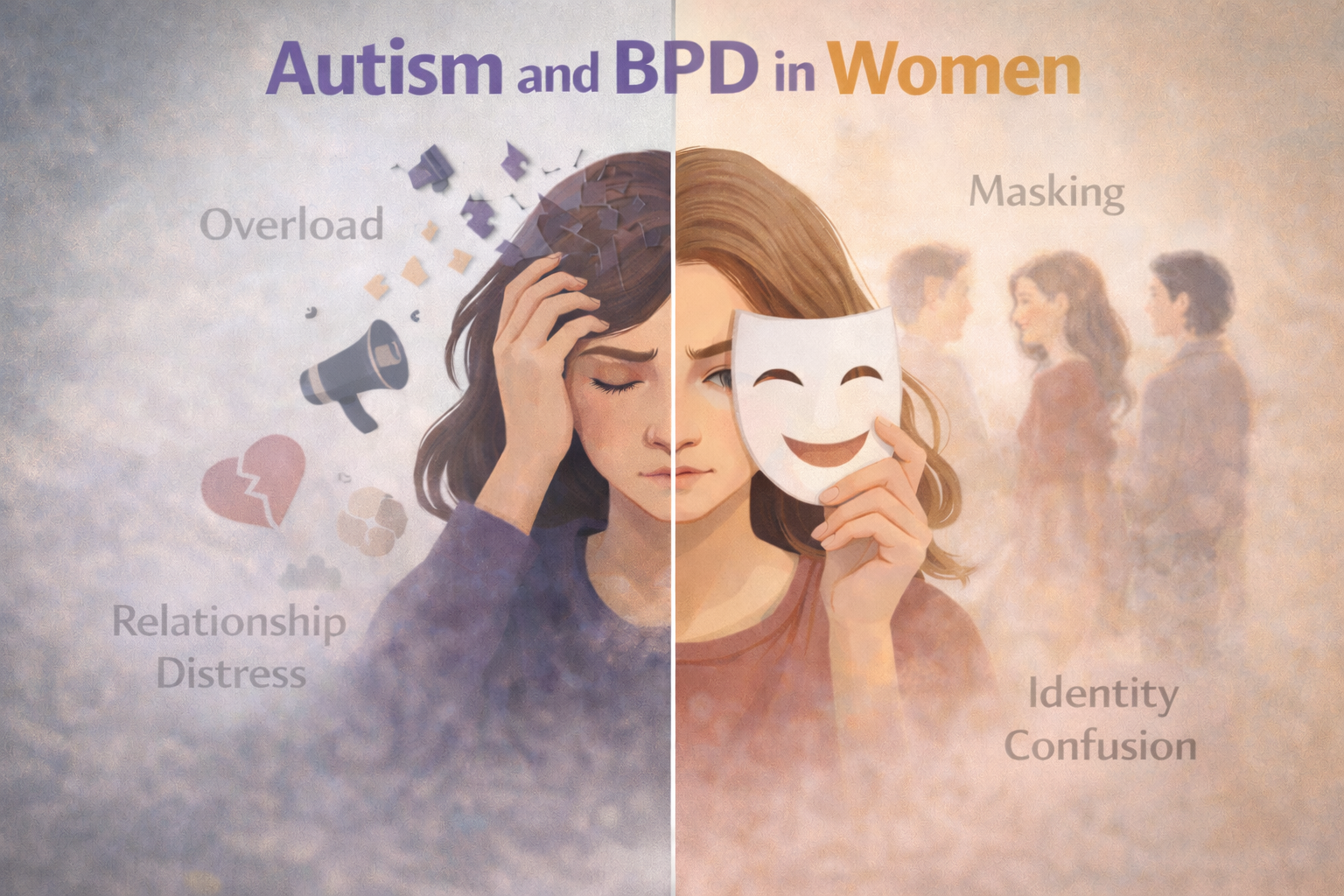
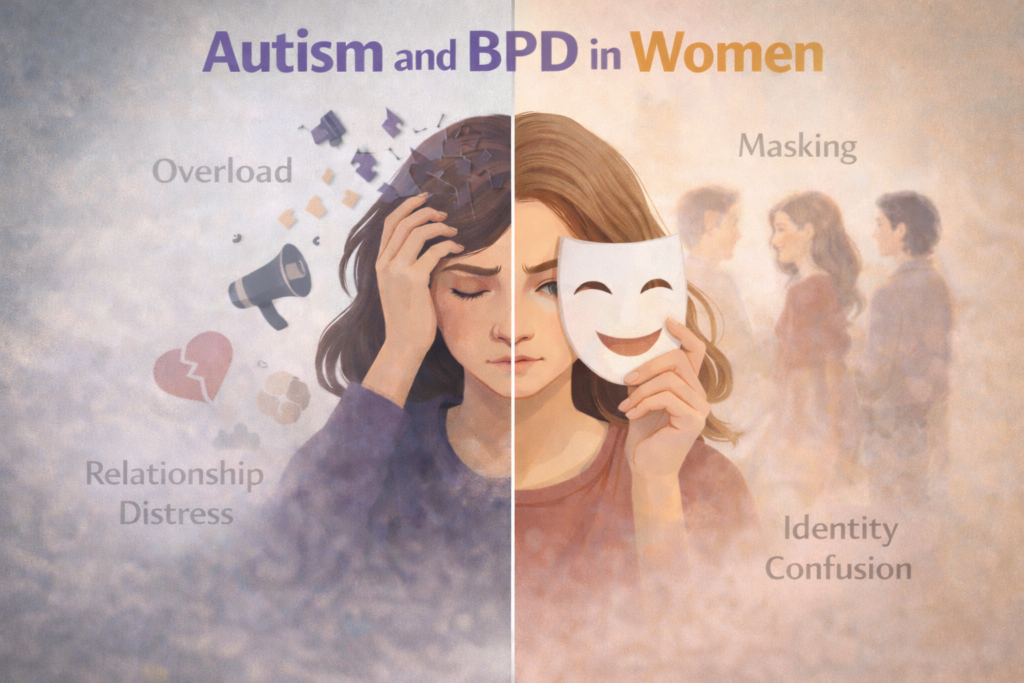
That distinction matters. Autism and BPD in women can look similar on the surface, but the underlying pattern still matters.
Because if what you are calling “instability” is actually overload, burnout, dissociation, trauma, or chronic masking, the next step that helps may look very different from the next step you would take if the pattern fits BPD more closely.
If this topic is already sending your brain into a loop, start with the Overthinking Survival Kit.
60-Second Answer
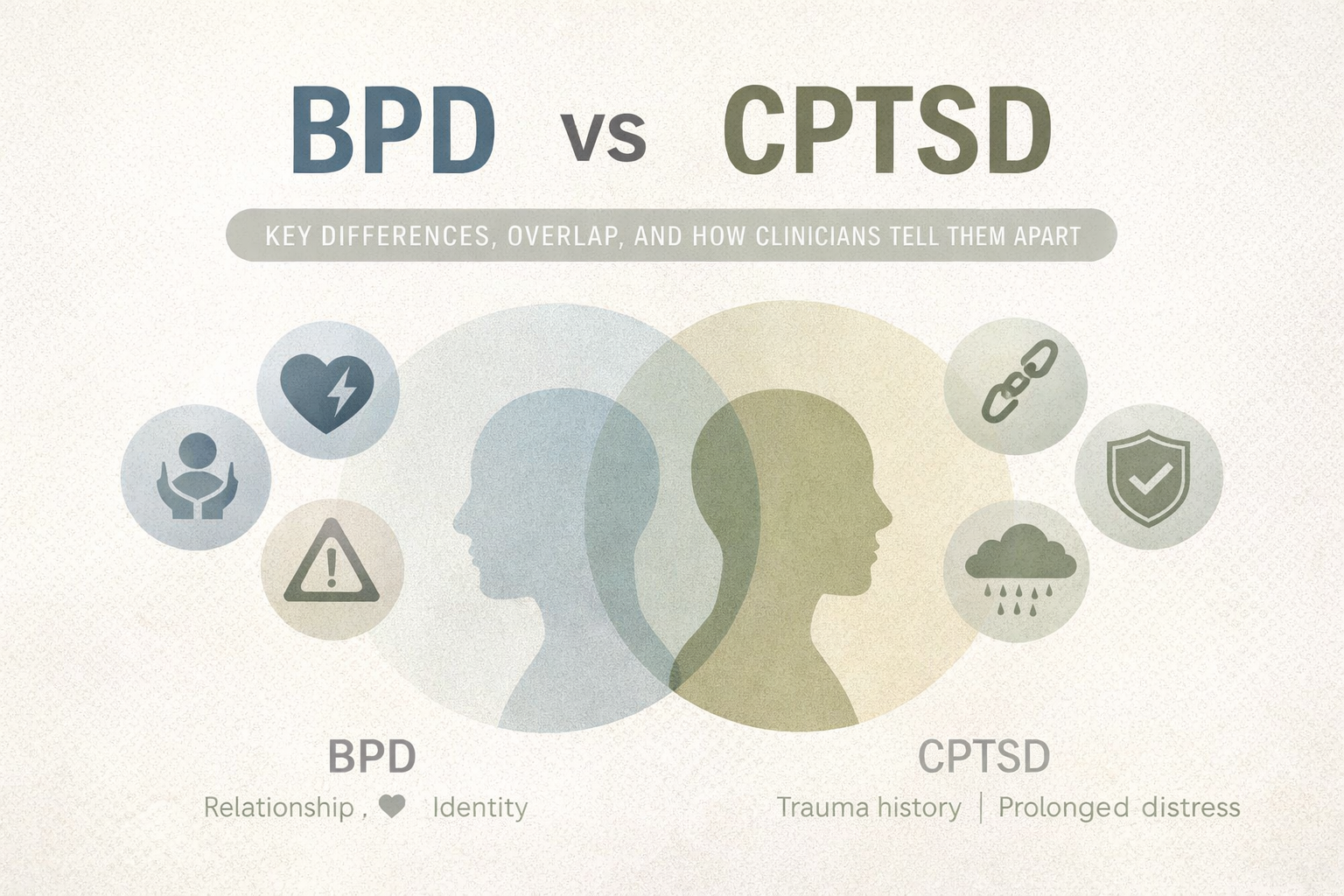
Autism and BPD in women can overlap on the surface.. Emotional dysregulation, relationship distress, identity confusion, crisis behavior, and emptiness do not explain themselves. In some people, those patterns may be tied more closely to overload, masking, sensory strain, trauma, burnout, or dissociation. In others, they may fit a BPD pattern more closely. In some cases, both may be part of the picture. The goal is not to force a label on one trait. The goal is to slow the interpretation down and look at the full pattern over time.
Table of Contents
- Why Autism and BPD in Women Get Confused
- Trait 1: Emotional dysregulation, meltdowns, and shutdowns
- Trait 2: Relationship instability
- Trait 3: Identity confusion
- Trait 4: Impulsivity, self-harm, and crisis behavior
- Trait 5: Chronic emptiness, numbness, and dissociation
- Questions to ask before you assume the label fits
- What to do next
Why Autism and BPD in Women Get Confused
This is the part internet conversations often skip.
A single trait can feel convincing in isolation. You relate to one description, then another, then another, and suddenly your brain is trying to reverse-engineer your whole life from fragments. That is understandable. It is also how people end up overconfident too fast.
One trait is never enough because traits do not live alone. They live inside patterns.
The useful questions are not just:
- What happened?
- Which label sounds closest?
- Which diagnosis has the most overlap with this one moment?
The better questions are:
- What tends to trigger it?
- What was building before anyone else saw it?
- Does it happen mostly in relationships, or across settings?
- What does recovery actually cost?
- Has this been here for a long time, or did it intensify after trauma, burnout, chronic stress, or long-term invalidation?
That is why this conversation needs more than symptom matching.
The point is not to talk you out of your instincts. The point is to slow the process down enough that you can stop treating the visible behavior like the whole explanation.
Trait 1: Emotional dysregulation, meltdowns, and shutdowns
What gets called a mood swing is not always the same thing.
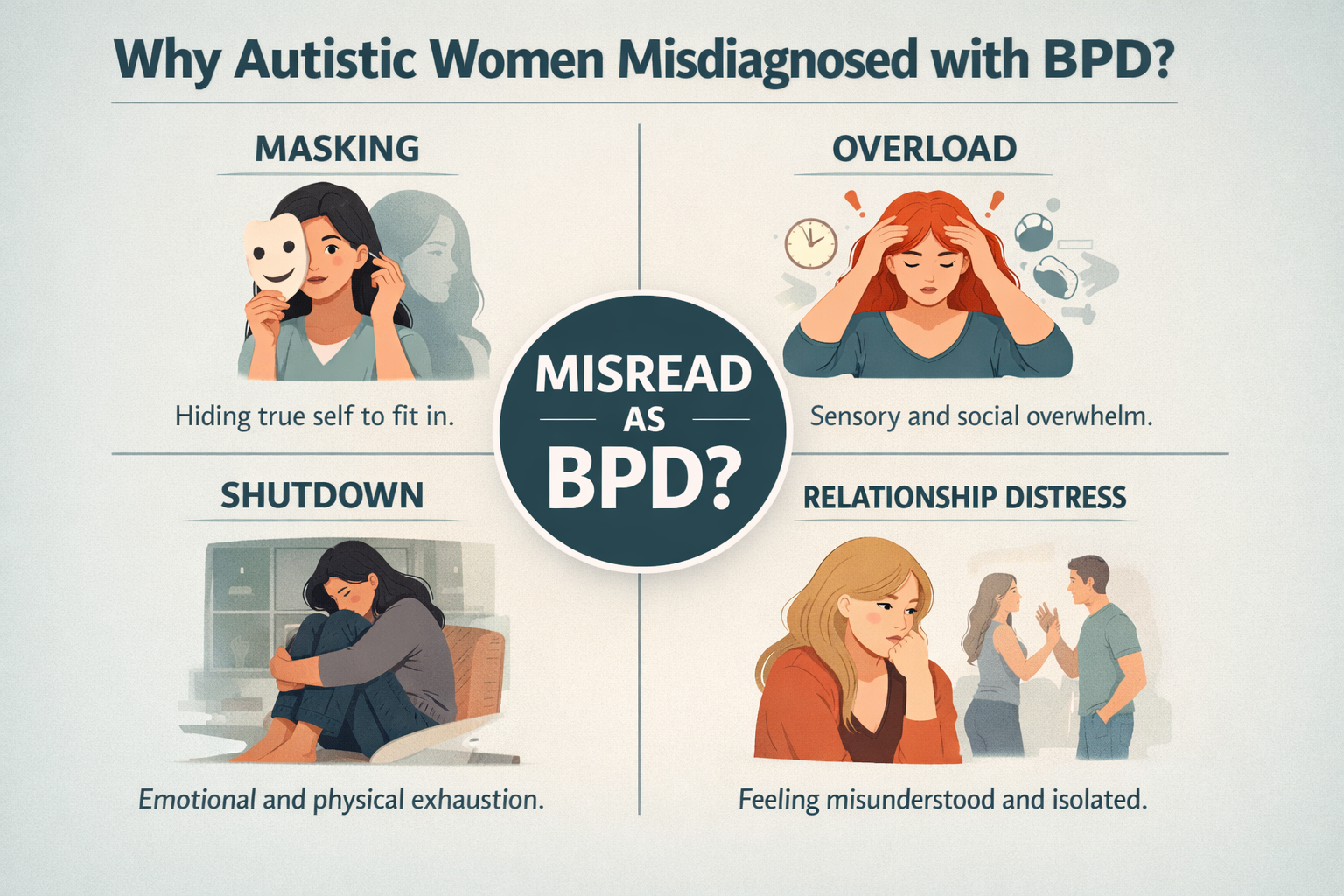
Sometimes what looks sudden from the outside is the endpoint of overload. Noise. Demand. Masking. Change. No recovery time. Then one more thing.
From the outside, it may look disproportionate. From the inside, it may feel more like: I was already at capacity.
That distinction matters because emotional dysregulation can happen in both autism and BPD.
In some autistic people, intense reactions may be closely tied to overload, depletion, shutdown, abrupt change, sensory strain, or the cumulative cost of holding it together too long. In BPD, dysregulation may also show up strongly around perceived relationship threat, abandonment, or rapid shifts in interpersonal meaning.
The overlap is real. That is exactly why surface behavior is not enough.
A more useful question is this:
Was this mainly about conflict itself? Or was conflict the last straw in an already overloaded system?
That will not diagnose anything. But it may help you ask better questions.
It can also help you stop misreading your own experience. A person can look back on an intense reaction and assume, “I’m unstable,” when the fuller picture is actually hours or days of accumulated strain. That does not erase the impact of the reaction. It does change the meaning of it.
And meaning matters, because the right next step depends on what was driving the spike in the first place.
Trait 2: Relationship instability
Relationship distress is real, no matter what is driving it.
But relationship distress by itself is not specific enough to tell you whether you’re looking at autism, BPD, trauma, or some overlap.
This is one of the easiest places to get lost because relationship pain gets attention fast. It is visible. It is emotional. It often comes with shame. And once shame gets involved, people start reaching for explanations quickly.
Sometimes what gets called “push-pull” is social confusion, flooding during conflict, literal interpretation under stress, repeated misattunement, or losing access to words when overwhelmed. From the outside, that can look inconsistent. Too much, then gone. Warm, then unreachable.
But those patterns do not all mean the same thing.
One useful question is this:
Is the relationship itself the emotional epicenter? Or is the relationship where overload, misreading, and shutdown become most visible?
That is not the whole assessment. It is just a better starting point than: “You struggle in relationships, so this must be BPD.”
This section matters because repeated misunderstanding can create real attachment pain. If you have spent years being misread, criticized, rejected, or chronically confused in relationships, the distress can be intense. You may become hyper-alert. You may over-explain. You may pull back fast. You may feel like closeness itself is exhausting, even when you want it.
That pain is real.
It still does not make relationship distress specific enough to answer the diagnostic question by itself.
The more useful move is to get curious about the pattern underneath the pain.
Trait 3: Identity confusion
A lot of people hear “unstable sense of self” and immediately think BPD.
But identity confusion can happen for different reasons.
If you’ve spent years masking, adapting, hiding needs, and performing your way through relationships or work, you may end up disconnected from your own preferences, limits, and internal signals.
That can sound like:
“I don’t know who I really am.”
“I trust other people’s read on me more than my own.”
“I feel most like myself when I’m alone.”
“I can perform a version of myself, but I don’t always feel connected to it.”
That may get labeled as instability very quickly. But chronic adaptation can blur self-trust in ways that are easy to misread.
This is one of the most painful parts of the conversation because it is not just about symptoms. It is about selfhood.
If you learned early that your natural reactions were too much, too confusing, too inconvenient, or too hard for other people to understand, adaptation can become automatic. And when adaptation becomes automatic, self-trust can start to disappear quietly. You may become skilled at reading the room while becoming less and less clear on what is actually yours.
That does not automatically mean autism. It also does not make identity disturbance unreal.
It means the history matters.
Again, the point is not to force an answer from one trait. The point is to slow the interpretation down enough to ask whether what looks like instability may also reflect years of self-editing, chronic adaptation, and loss of trust in your own internal experience.
Trait 4: Impulsivity, self-harm, and crisis behavior
This is one of the easiest places for stigma and bad assumptions to take over.
High-risk behaviors should always be taken seriously. Their function should not be guessed from the outside.
That matters because once people guess function from the outside, stigma fills in the blanks.
Sometimes those behaviors are attempts to reduce overwhelming internal distress quickly. That does not make them safe. It does mean context matters.
Questions like these can help clarify the pattern:
- What was building in the hour before?
- What was happening in my body?
- How overwhelmed was I?
- Was I overloaded, panicked, ashamed, dissociated, or trying to communicate distress?
This part is especially important because people often feel intense shame after the fact. They judge the behavior first and never get to the question underneath it. But if you skip the question underneath it, you miss information that may actually help reduce risk in the future.
That does not mean every behavior has a clean explanation.
It means you do not help yourself by acting as if all crisis behavior means the same thing.
If self-harm or suicidal thoughts are part of the picture, this is not something to sort out from internet content alone. Professional support matters, and immediate crisis support may be needed. For U.S. crisis support, use 988: https://988lifeline.org/
Trait 5: Chronic emptiness, numbness, and dissociation
One of the easiest ways to get misunderstood is to say “I feel empty” when what you really mean is “I feel gone.”
“Empty” can mean very different things.
Sometimes it points to chronic emptiness. Sometimes it means numbness, shutdown, burnout, alexithymia, dissociation, or severe depletion.
Those are not interchangeable experiences, even if people use similar words for them.
This is where stopping at the label can become especially unhelpful. “Empty” sounds like one neat description. But on the inside, one person may mean hollow. Another may mean shut down. Another may mean disconnected from the body. Another may mean too exhausted to locate any clear feeling at all.
So instead of stopping at the word, ask:
Does this feel like hollowness?
Exhaustion?
Going offline?
Disconnection from my body?
Trouble identifying what I feel?
Shutdown after too much input?
Descriptions are not explanations.
And if you stop too early, it is easy to land on the wrong one.
This is also one reason burnout gets missed. When people do not have good language for overload, depletion, or dissociation, they often reach for whatever emotional word feels closest. That is human. It is also why careful interpretation matters.
Why this matters
When the explanation is off, people can spend years focusing on the wrong pattern.
Sometimes the visible behavior gets all the attention, while overload, masking, sensory strain, trauma, burnout, or dissociation go unrecognized.
That can shape everything:
- the language you use for yourself
- the kind of support you seek
- the kind of support you reject
- the shame you carry
- the story you tell yourself about why things feel so hard
And when the story is off, the next step can be off too.
Trauma can complicate all of this further by affecting arousal, trust, threat detection, identity, and felt safety. So if trauma is part of the picture too, the answer may not be simpler.
It may be more layered.
That does not mean you need a perfect explanation right away.
It means you deserve a careful one.
Questions to ask before you assume the label fits
If you are trying to make sense of your pattern, it may help to bring questions instead of only conclusions.
Here are some useful ones:
- What tends to happen right before I shut down, escalate, or spiral?
- Do my biggest spikes happen mostly around relationship threat, or also around sensory overload, abrupt change, and cumulative depletion?
- How much of my daily functioning depends on masking?
- Do I lose access to language when overwhelmed?
- What does recovery cost me after high-intensity moments?
- What role does trauma seem to play in the pattern?
- Which experiences have been present for a long time, and which intensified later?
- When I say “empty,” “unstable,” or “too much,” what do I actually mean?
These questions do not diagnose you.
They do something better.
They help you move from self-judgment to pattern recognition.
And that is often where clarity starts.
What to do next
If this topic is landing hard, do not force certainty too fast.
Track the pattern over time:
- triggers
- sensory load
- masking
- relationship context
- what happens before shutdown, escalation, or spiraling
- what recovery actually costs
Because the worst moment is rarely the whole story.
The pattern across time usually tells you more.
And if your brain goes straight into over-analysis when something resonates, start with the Overthinking Survival Kit.
It’s there to help you get out of the mental loop and into something more grounded before you start trying to interpret everything at once.
If this article raises the question, what if my BPD diagnosis never really fit? watch this next:
What If Your “BPD” Is Actually Autism?
https://youtu.be/Y2F697312CE
Autism and BPD in women can look similar in isolated moments, but the pattern over time usually tells you more.
The goal is not to force a label.
It’s to understand the pattern well enough to get the right kind of support.