Why Doesn’t Grounding Work for Me? (What to Try Instead)
If you’ve searched “why doesn’t grounding work for me?” you’re not alone. A lot of people—especially autistic, ADHD, BPD, and C-PTSD folks—try “generic grounding” and end up feeling more anxious, annoyed, flooded, or shut down.
That doesn’t mean you failed.
It usually means the tool didn’t match your nervous system.
Grounding isn’t one technique. It’s a category. And for ND/trauma brains, it often needs the right dose, the right channel, and the right timing.

60-Second Answer (Save This)
If grounding isn’t working, do this:
- Ask: Do I need more input or less input?
- If you feel revved up (panic/urgency/buzzing) → try pressure or cool sensation
- If you feel overloaded (too much sound/light/words disappearing) → reduce stimulation first
- If inside-the-body attention makes it worse → use external anchors or short phrases
- Aim for a 10% shift, not calm
Grounding isn’t “erase feelings.”
It’s “change the channel enough to regain choice.”
Want a simple grounding menu you can circle ahead of time?
(FREE fillable plan) → When Everything Is Too Much
Quick note: This is educational content only and does not create a therapist–client relationship. It’s not therapy or crisis monitoring. If you’re at risk of harming yourself or someone else, contact local emergency services. In the U.S., call/text 988. https://988lifeline.org/
Quick Jump Links
- Why grounding can make you feel worse
- What grounding is actually for
- Revved up vs overloaded (pick the right tool)
- Grounding “families” that work better
- Mini demos (2 minutes total)
- Practice in yellow zone
- FAQs
Why Grounding Can Make You Feel Worse
Here are the most common reasons grounding backfires:
- Too much input: scanning the room can become threat scanning
- Too vague: “just notice” gives an ADHD/stress brain nothing to hold
- Wrong dose: some systems need stronger input; others need less
- Trauma pairing: body focus, closed eyes, or internal attention can spike panic
If a tool annoys you, blanks you out, or ramps you up—your nervous system is giving data.
Mismatch, not failure.
What Grounding Is Actually For
Grounding is a functional skill:
Bring enough attention to the present to keep overwhelm or urges from taking over.
Success can look like:
- delaying a text or decision
- getting speech back
- dropping intensity by one point
- feeling 10% more choice
The goal is less awful, not calm.
Revved Up vs Overloaded: Pick the Right Tool
Before you try another technique, sort the state.
Revved up
Common signs:
- urgency (“I have to act now”)
- buzzing energy, heat in chest
- panic, rage, impulse pressure
Try more input:
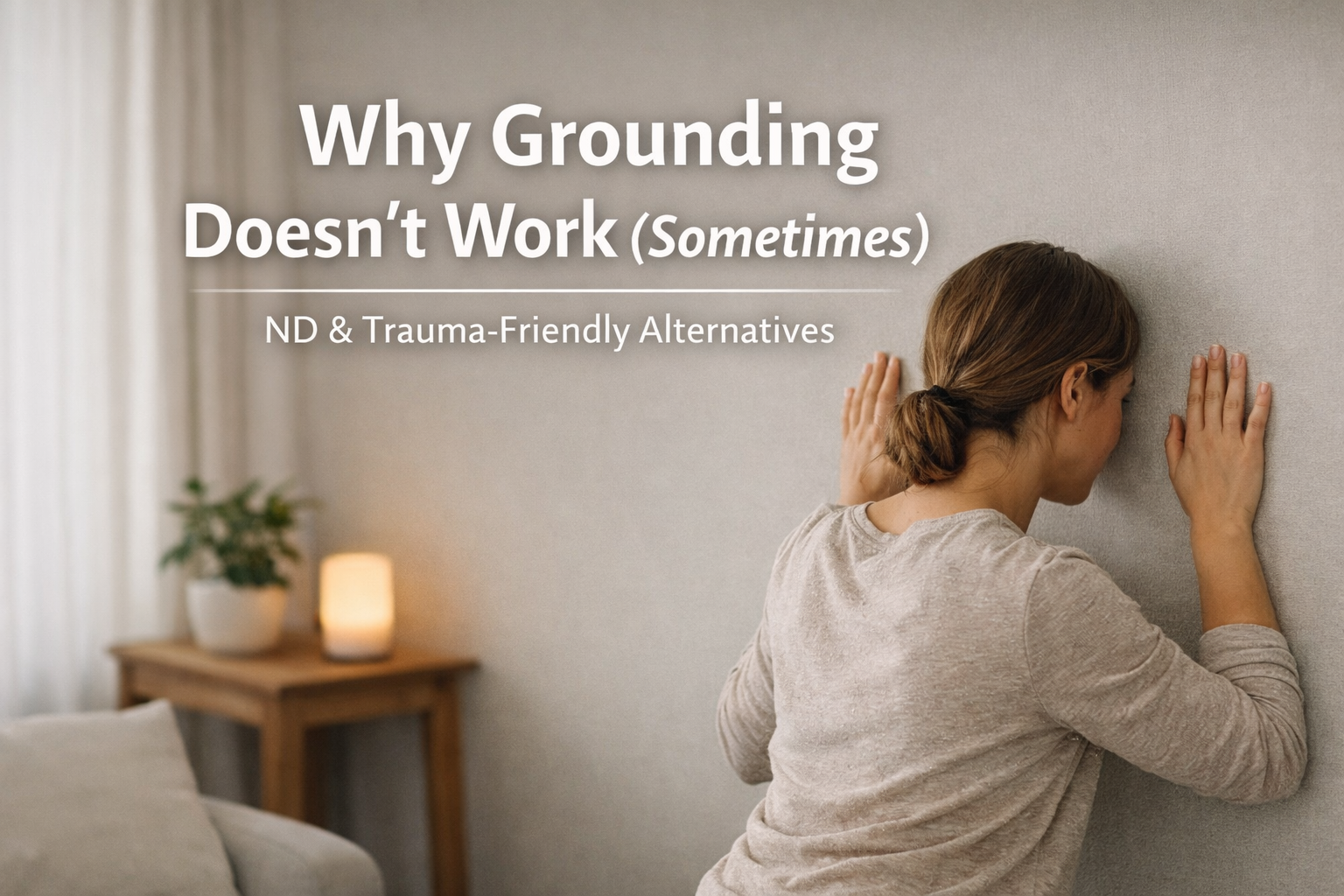
- Pressure (wall press, chair push-down, resistance band)
- Structured breath (inhale 4, exhale 6)
- Cool sensation (cool cloth/pack, cool object in hand)
Overloaded
Common signs:
- sound/light feels sharp
- words disappearing
- blankness, shutdown, “too much”
Try less input:
- dim lights, reduce sound
- soft gaze on one fixed point
- face a wall / turn away from stimulation
- one object, three facts (no scanning)
Different state. Different first move.
Grounding Families That Work Better (Choose One)

Use the least annoying option. Try briefly. Track what happens.
1) Pressure / movement
Often best for revved-up urgency.
- wall press
- chair push-down
- squeeze pillow
- band pull
2) Low-input grounding
Often best for overload/shutdown.
- reduce sound/light
- hoodie/hat
- one fixed point
- quiet corner
3) Narrow sensory focus
Contained input, not scanning.
- 3 things you see
- 1 sound
- 1 texture
4) Words / scripts
When body attention makes it worse.
- “This is a wave.”
- “I don’t have to act on this urge.”
- “My body is alarmed; I am safe enough right now.”
5) Temperature (optional)
Often helps when your body is in high gear.
- cool cloth on cheeks/neck
- cool water on wrists
- cool object in hand
If cold exposure isn’t medically safe for you, skip it. If it feels like too much, use cool/room-temp instead.
Mini Demos (Try One)
Consent rule: Try it if you want. If it worsens, stop and switch.
Demo A: Wall press (60 seconds)
Hands on wall.
Push 10 seconds.
Release 10 seconds.
Repeat 3 times.
Demo B: Structured breathing (60 seconds)
Inhale 4.
Exhale 6.
Count it.
Longer exhale.
Demo C: Overload anchor (30 seconds)
Pick one neutral object.
Name three facts: “brown, square, still.”
Feel one solid surface supporting you.
If it helps even a little, that counts.
Practice in Yellow Zone
The worst time to pick a grounding tool is when you’re already at peak intensity.
Practice at 4–6/10 (mild-to-moderate distress) for 30–90 seconds.
Track:
- helped / didn’t help
- tolerable / too much
- more input / less input
Your nervous system learns through repetition, not insight.
If choosing tools when overwhelmed is hard, the free plan When Everything Is Too Much includes a grounding menu you can circle ahead of time → When Everything Is Too Much Crisis Plan
FAQs
Why does grounding make me more anxious?
Often because the tool increases scanning/sensory input, or it directs attention inward in a way that feels unsafe.
Is grounding supposed to calm me down?
Not necessarily. It’s meant to restore enough choice to reduce impulsive action and help you take one safer next step.
What if none of this works?
Switch channel: pressure → low-input → words. Practice in yellow zone. Adjust dose. Keep what helps; drop what doesn’t.
Is this different for ADHD/autism/C-PTSD/BPD?
Often, yes. Attention regulation, sensory processing, and trauma pairing can change what works best.
When should I get more support?
If spikes are frequent, impairing, or include safety risk, professional support can help. If you’re in immediate danger, contact emergency services.
What to Do Next
If grounding hasn’t worked before, don’t conclude “grounding doesn’t work.”
Conclude: wrong channel or wrong dose.
Start with two options:
- one for revved up
- one for overload
And if you want a simple grounding menu you can circle ahead of time:
When Everything Is Too Much Plan
Prefer a walkthrough with demos?
→ WATCH: Grounding That Actually Works for Autistic, ADHD, BPD & C-PTSD Brains