(Autism, ADHD, BPD & C-PTSD)
If you’re trying to figure out whether you’re experiencing autistic burnout, depression, or a crisis — and none of those labels feel quite right — you’re not alone.
Many autistic, ADHD, BPD, and C-PTSD adults reach a point where everything feels heavy, confusing, and overwhelming. The hardest part often isn’t the distress itself — it’s not knowing what is happening or how to respond.
This post is not a diagnosis.
Think of it as a map, not a label — a way to orient when things feel blurred.
And just to name this early: if you’re feeling unsafe or unable to keep yourself safe, reaching out for immediate support matters. I’ll say more about that later.
Why autistic burnout, depression, and crisis feel so similar
From the inside, autistic burnout, depression, and crisis states can look almost identical.
All three can involve:
- low energy or exhaustion
- withdrawal or shutdown
- difficulty functioning
- crying, numbness, or emotional overwhelm
For neurodivergent and trauma-affected nervous systems, stress responses often overlap. Years of masking, pushing past limits, and navigating unsafe or unpredictable environments make it genuinely difficult to separate one state from another.
This confusion isn’t a lack of insight.
It’s what happens when multiple nervous-system responses are active at the same time.
Autistic burnout vs depression: what’s different underneath
What autistic burnout often looks like

Autistic burnout usually develops from long-term overload, not a single bad day.
Common signs of autistic burnout include:
- deep exhaustion that doesn’t resolve with sleep
- sensory or social overwhelm that used to be manageable
- needing much more recovery time than before
- shutdown, withdrawal, or going quiet
- reduced access to skills or capacities you once had
Many people describe autistic burnout as:
“My battery feels permanently empty.”
“I can’t access the parts of me that used to work.”
“Everything takes more effort than it should.”
Autistic burnout isn’t about motivation or willpower.
It’s about capacity.
Burnout can exist on its own — and it can overlap with or slide into depression.
What depression often feels like
Depression tends to have a different emotional texture.
Common experiences include:
- persistent low mood or heaviness
- loss of interest or pleasure
- hopelessness or emptiness
- slowed thinking or movement
- sometimes numbness rather than intense emotion
Some people describe depression as:
“Everything feels flat.”
“Nothing matters.”
“I can’t imagine things changing.”
For others, depression can also involve irritability or restlessness — not just sadness.
Depression is often a dimming of energy, emotion, and possibility.
If low mood and hopelessness persist even when rest increases, depression deserves attention too.
What a crisis can look like (especially with BPD traits or trauma)
A crisis state is usually more acute and more relationally triggered.
It often includes:
- intense shame or fear
- anger turned inward or outward
- identity confusion (“I don’t know who I am”)
- relationship panic
- strong urges to escape or make drastic changes
Crisis spikes often show up around:
- conflict
- perceived rejection
- emotional closeness
- feeling misunderstood
These urges can feel urgent and overwhelming.
They are signals, not instructions — signs that your nervous system perceives threat, not proof that you need to act immediately.
Quick comparison: burnout vs depression vs crisis
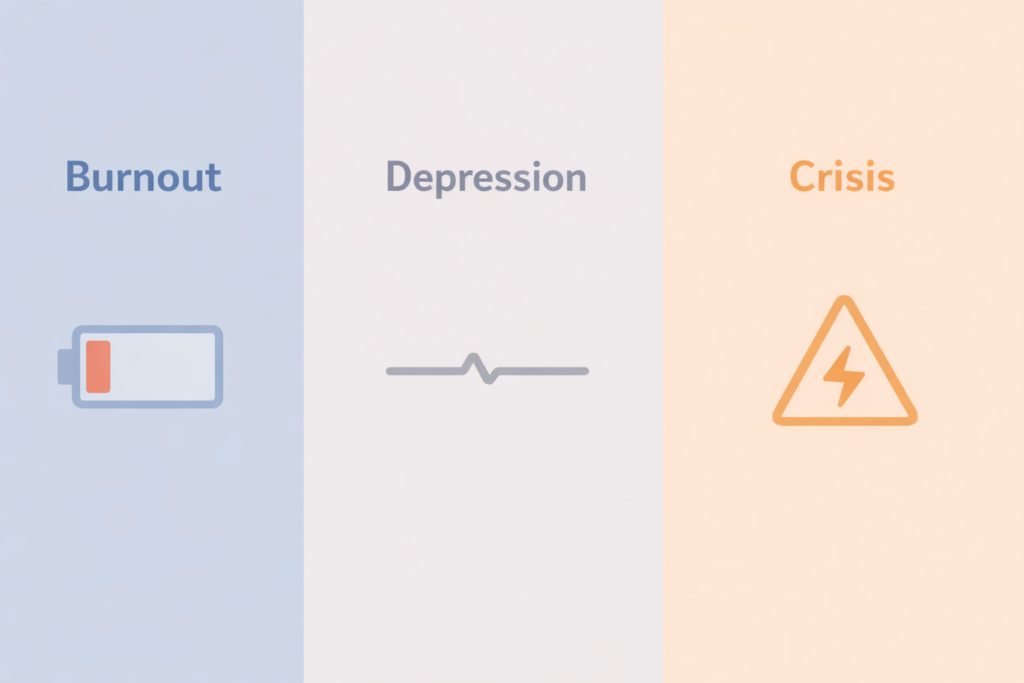
This is not a test — just a snapshot.
Burnout often feels like:
- exhaustion from long-term overload
- reduced capacity
- needing much more rest and recovery
Depression often feels like:
- heaviness or numbness
- loss of interest or hope
- slowed thinking and energy
Crisis often feels like:
- emotional spikes
- relationship-driven distress
- urgency to escape or change something immediately
You may recognize yourself in more than one column. That’s common.
Gentle reflection questions to help you orient
Instead of trying to label yourself, it can help to orient with curiosity.
Not forever — just for this moment.
You might ask:
- What was happening right before this started?
Long-term exhaustion? A specific conflict? A stretch without rest? - Does this feel closer to exhaustion, hopelessness, or relationship panic?
You don’t need the perfect word — just the closest one. - How long has this been going on?
Days, weeks, months? Does it fluctuate or feel stuck?
These questions aren’t about getting it “right.”
They’re about gathering information with less self-blame.
When intensity is high, naming the state matters less
Whether this is autistic burnout, depression, a crisis, or a mix of all three, there are moments when intensity hits 8, 9, or 10 out of 10.
At those levels, the priority is not:
- insight
- analysis
- the perfect label
The priority is:
- safety
- containment
- not making things worse
Understanding comes later.
Support comes first.
A simple support plan for days when you can’t tell what this is

For days when everything feels like too much — and you genuinely can’t tell what’s happening — having structure helps.
I created a free, plain-language resource called When Everything Is Too Much.
It’s designed for moments when your brain is barely online.
The free PDF includes:
- a simple 0–10 check-in
- a pause → safety → grounding checklist
- a grounding menu you can choose ahead of time
- a mini safety snapshot
You can print it or save it on your phone so it’s there before the next spike.
👉 Download the free plan here:
When Everything Is Too Much Plan
(This resource is supportive and educational. It doesn’t replace therapy or emergency care.)
Frequently asked questions
Do I need to know which one this is to get help?
No. You don’t need a perfect label to deserve support, especially during high-intensity moments.
Can autistic burnout, depression, and crisis overlap?
Yes. Many people experience elements of more than one at the same time, especially when neurodivergence and trauma are involved.
Why does this keep happening to me?
Because your nervous system learned ways to survive long-term stress and overwhelm. These patterns are adaptive — even when they cause pain later.
When should I reach out for professional or emergency help?
If you feel unable to keep yourself safe, or someone else is in immediate danger, reaching out to local emergency services or a crisis line matters.
You don’t need the right label today
If you can’t neatly sort your experience into one category, that doesn’t mean you’re failing.
It means your nervous system — and your history — are complex.
A small next step that helps many people:
download the plan and keep it somewhere easy to reach.
You don’t have to figure everything out today.
Getting through today safely is enough.
Important note
This post and the free resource are for education and support — not a replacement for therapy or emergency care.
If you’re in immediate danger or unable to keep yourself safe, please contact local emergency services or a crisis line.