Why intense urges show up when you’re overwhelmed — and what helps you pause before you regret it

If you’ve ever thought, “I might blow everything up if this feeling doesn’t stop,” you’re not alone.
For many autistic, ADHD, BPD, and C-PTSD adults, intense overwhelm doesn’t just feel painful — it comes with urgent impulses:
- to send the text
- to quit the job
- to end the relationship
- to disappear
- to make a drastic move just to end the feeling
These urges can feel frightening, shameful, or out of character.
This post is for people who experience impulsive urges during emotional overwhelm — especially if you’ve been told you’re “self-sabotaging,” “too much,” or “burning bridges” when you’re actually in a nervous-system emergency.
Impulsive urges are a nervous system response, not a character flaw
When overwhelm hits hard, the nervous system shifts into survival mode.
At this point, your brain isn’t asking:
“What’s the long-term consequence?”
It’s asking:
“How do I make this stop right now?”
For neurodivergent and trauma-affected nervous systems, intense urges often serve one of three survival functions:
- ending emotional pain as fast as possible
- regaining a sense of control
- preventing future hurt or rejection
From the outside, these urges can look reckless or destructive.
From the inside, they’re often emergency strategies — even when they cause harm later.
Why overwhelm leads to “burn it all down” thinking
Several factors make impulsive urges more likely during overwhelm:
1. Loss of access to thinking
At high intensity, the brain’s reasoning systems go offline.
Black-and-white thinking takes over:
- All or nothing
- Now or never
- If I don’t act, I’ll fall apart
This isn’t immaturity.
It’s neurobiology under stress.
2. Trauma history
If past experiences taught you that:
- you’re not heard until things escalate
- connection is unpredictable or unsafe
- pain only ends when something drastic happens
your nervous system may push for action when distress peaks.
3. Neurodivergent processing
Autistic and ADHD nervous systems often:
- experience stronger internal signals
- struggle more with uncertainty
- take longer to return to baseline
When overwhelm hits, the urge to end the state immediately can feel unbearable.
The “impulse cycle” that keeps repeating
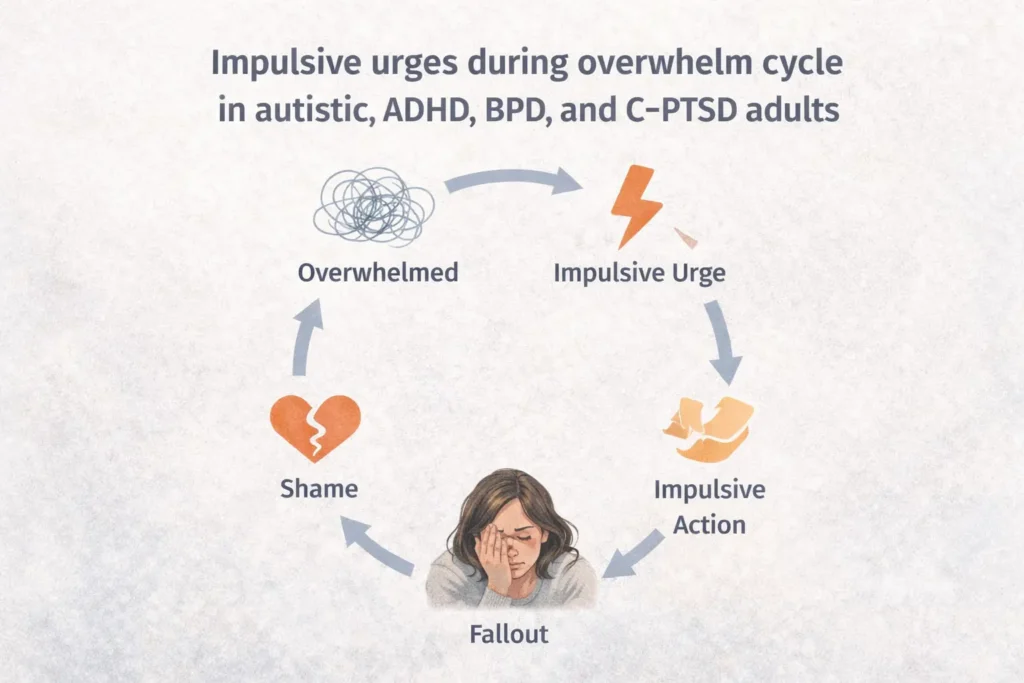
Impulsive urges often follow a predictable loop:
- Overwhelm spikes
- Urge to act immediately
- Action brings brief relief
- Fallout appears (relationships, work, safety)
- Shame and regret increase dysregulation
- Nervous system becomes more reactive next time
This doesn’t mean you’re doomed to repeat it forever.
It means your nervous system learned a strategy that worked briefly — and hasn’t yet been given safer alternatives.
When you’re overwhelmed, the goal isn’t control — it’s containment
A common misunderstanding is that you need to stop having impulses.
That’s not realistic at high intensity.
What is realistic:
- pausing before acting
- reducing harm while intensity is high
- buying time for your nervous system to settle
Containment is not suppression.
It’s temporary protection.
One rule that helps during intense urges
When overwhelm is high, one guideline can reduce a lot of damage:
No big decisions above an 8/10.
This doesn’t mean never.
It means not right now.
Above an 8/10:
- insight doesn’t land
- urgency distorts perspective
- consequences are harder to see
Pausing protects your future self.

What to do when you feel like you might blow everything up
When the urge is loud, think small and concrete.
1. Pause your next move (10–30 seconds)
Put the phone face down.
Step into another room.
Sit on your hands.
You’re not deciding what to do —
you’re deciding not to do the most damaging thing yet.
2. Check basic safety
Ask:
- Am I safe enough right now?
- Is anyone else in immediate danger?
This isn’t about feeling okay.
It’s about preventing irreversible harm.
If safety isn’t there, reaching out for urgent support or emergency services is part of the plan.
3. Pick one grounding action
One is enough.
Options many people find helpful:
- cold water or ice
- slow breathing with a long exhale
- pressing your body into a wall or floor
- reducing sensory input (dim lights, quiet space)
The goal isn’t calm —
it’s slightly less intense.
A half-point drop still matters.
Why having a plan before the urge hits matters
When your nervous system is overwhelmed, you can’t problem-solve from scratch.
That’s why having a simple support plan ahead of time helps.
I created a free, plain-language plan called When Everything Is Too Much for moments exactly like this.
Clinically, tools like this are often called crisis plans — meaning extra structure during high-intensity moments, not emergency care and not a replacement for professional support.
The free PDF includes:
- a 0–10 intensity check
- a pause → safety → grounding checklist
- a grounding menu you choose ahead of time
- a mini safety snapshot
👉 Download the free plan here:
When Everything is Too Much Plan
(This resource doesn’t replace therapy or emergency services. If you feel unable to keep yourself safe, reaching out matters.)
Why this approach works for impulsive urges
At high intensity, your nervous system doesn’t respond to logic.
It responds to:
- reduced stimulation
- physical grounding
- time
Structure helps you:
- interrupt impulsive action
- reduce fallout
- protect relationships and opportunities
You’re not failing when you need structure.
You’re responding wisely to how your nervous system works.
Frequently Asked Questions About Impulsive Urges & Overwhelm
Why do I want to ruin things when I’m overwhelmed?
Because your nervous system is trying to end pain or regain control — not because you actually want destruction.
Are impulsive urges the same as self-sabotage?
Often, no. Many impulsive urges are protective strategies that become harmful when overused.
Why do urges feel so urgent?
Urgency increases when the brain’s threat system is active and reasoning systems are offline.
Do these urges mean something is “wrong” with me?
No. They point to nervous system overload, not a moral or personality flaw.
Can this get better?
Yes — with understanding, structure, and safer alternatives, many people experience fewer high-intensity episodes and less fallout over time.
If you’re here, it means you’re paying attention
Feeling like you might “blow everything up” doesn’t mean you’re dangerous or broken.
It means your nervous system is overwhelmed and asking for relief.
A small next step that helps many people:
download the plan and keep it somewhere you’ll see it when intensity spikes.
You don’t have to fix everything today.
Pausing is enough for now.
Important note
This post and the free resource are for education and support — not a replacement for therapy or emergency care.
If you’re in immediate danger or unable to keep yourself safe, please contact local emergency services or a crisis line.